Single-storey rear extensions are the most common job we draw. They're also the one where the permitted development rules trip people up most, usually because someone read "up to 6 metres" online and assumed that was automatic.
The two limits that matter
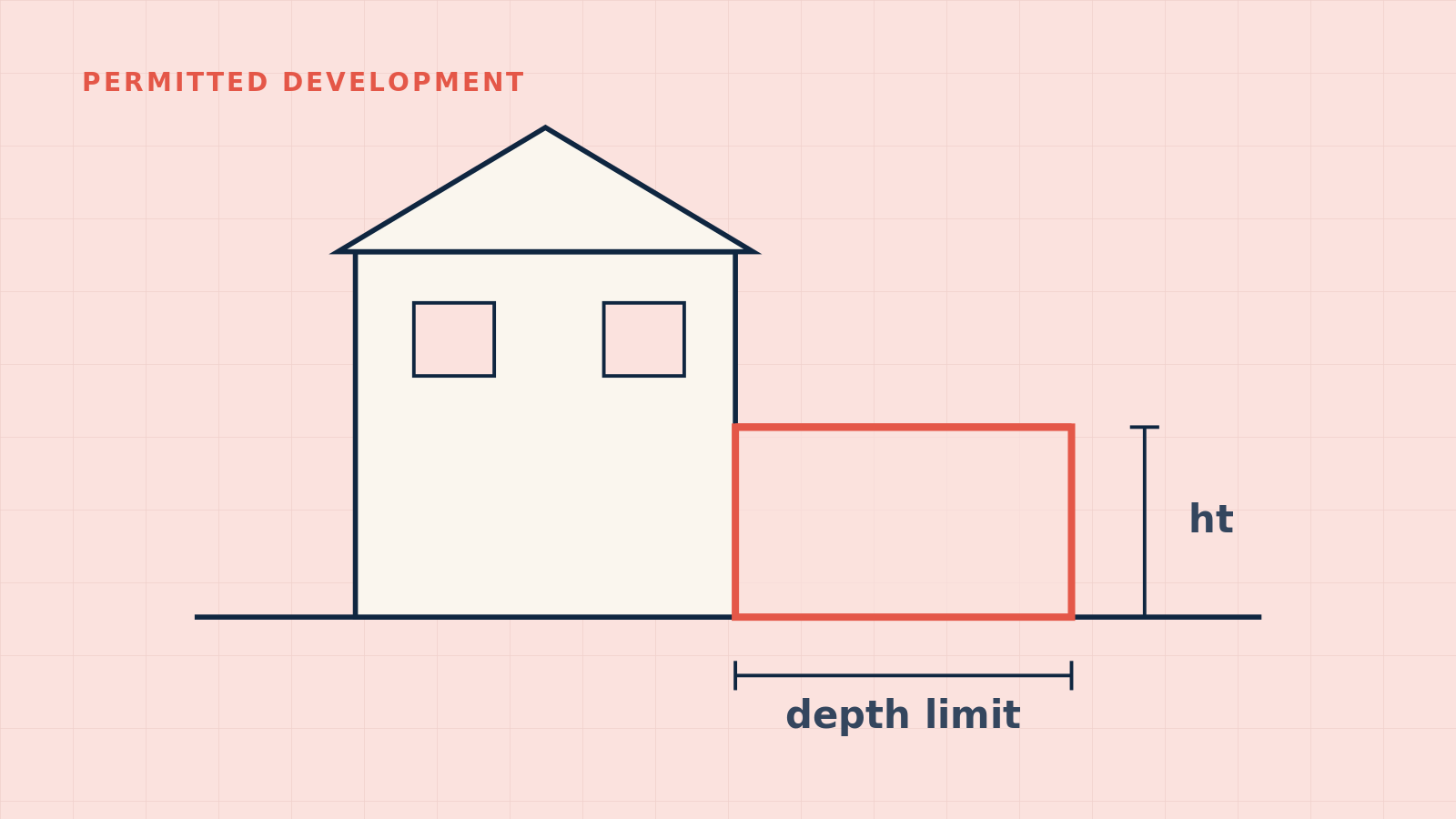
Under permitted development, a single-storey rear extension can go:
- Up to 3m beyond the original rear wall for a terraced or semi-detached house
- Up to 4m beyond the original rear wall for a detached house
That's the limit with no extra paperwork. Build within those numbers and a few other constraints (below) and you don't talk to the planning department at all.
"Original" means original
"Original rear wall" means as the house was built (or as it stood on 1 July 1948, whichever is later). If a previous owner has already added a 2m extension, you don't get another 3m on top, your allowance is whatever's left.
We measure the existing rear wall position from old planning records and the site visit. Catches a lot of people out, especially in terraces where everyone in the street has already done something.
The "larger home extension" route, up to 6m / 8m
The 6m / 8m figure you've probably seen comes from a different route: prior approval under the larger home extension scheme. This lets you extend:
- Up to 6m for a terraced or semi-detached
- Up to 8m for a detached
But it's not free PD, you have to submit a prior approval application to the council. They notify your neighbours, give them 21 days to object, and if anyone objects on amenity grounds the council decides whether to grant it.
Prior approval has its own council fee (current figure on the Planning Portal), takes roughly 8 weeks, and gives no guarantee. If a neighbour objects on amenity grounds, the council can refuse. Most go through, but the timing risk is real, if you've got a builder booked, an 8-week prior approval window can derail the start date.
The other rules you have to hit
Even within the 3m / 4m PD envelope, all of these need to be true:
- Maximum height of 4m to the ridge / eaves (for a flat-roofed extension, ridge = top)
- Eaves no higher than 3m if within 2m of a boundary
- No part of the extension forward of the front elevation
- Materials similar in appearance to the existing house
- No verandas, balconies or raised platforms
- The extension covers no more than 50% of the land around the original house
That last one, the 50% rule, is the one that bites people with already-extended properties. If previous owners have built outbuildings, sheds, conservatories or extensions that together with your proposal would cover more than half the original garden, PD doesn't apply.
Side and wraparound extensions, different rules
The 3m / 4m rule is for rear extensions only. Side extensions under PD have different limits:
- Single storey only
- Maximum height 4m
- Maximum width of half the original house width
- Cannot extend forward of the front elevation
A wraparound (rear + side) is treated as a single extension for PD purposes, which usually pushes the project over the 50% land coverage rule or the half-width rule. Most wraparounds we draw end up needing planning permission.
Conservation areas and Article 4
Same as for lofts: if your house is in a conservation area, listed, in an AONB, or under an Article 4 direction that's removed extension PD rights, you're applying for planning regardless of size. Many central London boroughs have Article 4 directions on rear extensions in conservation areas, Camden, Westminster, Kensington & Chelsea, parts of Hackney.
We check the council's online map for conservation area boundaries and Article 4 zones before you book.
What we draw for a PD-compliant extension
Even though you don't need planning permission, you still need:
- Building Control submission, full plans showing structural design, foundations, drainage, thermal performance
- Structural calculations for any new openings, beams or foundations
- Drainage drawings if you're connecting to existing sewers
That's exactly what's in the £1,650 extension package. The drawings are produced to a standard the council accepts and your builder can build from. No planning application means no planning fee, no 8-week wait, you go straight to Building Control and then on site.
If your extension is PD: drawings → Building Control → builder. Roughly 14 working days from us, then it's down to your build programme. If it isn't PD: drawings → planning application (8 weeks) → Building Control → builder. Add roughly 10 weeks to the timeline before the builder breaks ground.
TL;DR
- 3m (terraced/semi) or 4m (detached) is the PD rear extension limit
- 6m / 8m is possible but requires prior approval and an 8-week wait
- Side extensions have separate, tighter rules
- Conservation areas, listed buildings and Article 4 zones override PD
- We check all of this for your property before you book the drawing pack